Background
Background
01
As a musician learning to code, I noticed clear parallels between musical concepts (repeats, symbols) and programming logic (loops, conditionals).
I believed that I could leverage these correlations to build a platform that lets users transfer musical and programming concepts back and forth.
Benchmark
Benchmark
02
The idea of merging music and programming isn’t new. Some tools already explore this intersection.
The idea of merging music and programming isn’t new. Some tools already explore this intersection.
EarSketch
EarSketch
A browser-based learning environment that pairs a digital audio workstation with coding.
A browser-based learning environment that pairs a digital audio workstation with coding.

TunePad
TunePad
A online platform for creating music with the Python programming language
A online platform for creating music with the Python programming language
Workshop
Workshop
03
To uncover pain points and opportunities for improvement of existing tools, I designed an introductory Python workshop for beginners using EarSketch. Below is the workshop outline.
To uncover pain points and opportunities for improvement of existing tools, I designed an introductory Python workshop for beginners using EarSketch. Below is the workshop outline.

Pre-workshop Survey
Pre-workshop Survey
Demographic questions
Demographic questions
Demographic questions, including musical backgrounds
Demographic questions, including musical backgrounds
Coding Assessment
Coding Assessment
10 coding questions to assess performance before the workshop
10 coding questions to assess performance before the workshop


Workshop Session
Workshop Session
Introductory Python
Introductory Python
Teach basic coding concepts using EarSketch
Teach basic coding concepts using EarSketch
Behavior observation
Behavior observation
Note how participants engage and learn during the session
Note how participants engage and learn during the session
Post-workshop Survey
Post-workshop Survey
Evaluation
Evaluation
Collect overall experience and satisfaction ratings
Collect overall experience and satisfaction ratings
Coding assessment
Coding assessment
10 coding questions to assess performance after the workshop
10 coding questions to assess performance after the workshop
A total of five workshops were held at Georgia Gwinnett College toward the end of Spring 2022 semester under the supervision of Dr. Cengiz Gunay.
A total of five workshops were held at Georgia Gwinnett College toward the end of Spring 2022 semester under the supervision of Dr. Cengiz Gunay.
4/8
4/8
In-class Workshop
Intro to Computing course
Intro to Computing course
4/11
4/11
In-class Workshop
Intro to Computing course
Intro to Computing course
4/19
4/19
In-class Workshop
Digital Media course
Digital Media course
4/23
4/23
Title I School Event
—
—
4/30
4/30
Middle School Event
Super Saturday Series
Super Saturday Series
Participants
Participants
A total of 121 students participated in the workshops: 67 college students, 40 middle school students, and 14 Title I school students. Only college students were asked to complete surveys.
A total of 121 students participated in the workshops: 67 college students, 40 middle school students, and 14 Title I school students. Only college students were asked to complete surveys.

Completed Survey
Incomplete Survey
Completed Survey
Incomplete Survey
Of the 67 college student participants, 55 completed both the pre- and post-surveys.
Of the 67 college student participants, 55 completed both the pre- and post-surveys.

Non-IT Majors
IT Related Majors
Non-IT Majors
IT Related Majors
Only 8 college students were IT related major students.
Only 8 college students were IT related major students.

Not a musician
Musicians
(can read music)
Musicians
(can't read music)
Not a musician
Musicians
(can read music)
Musicians
(can't read music)
15 college students were musicians and 11 of them could read music sheet.
15 college students were musicians and 11 of them could read music sheet.

New to
programming
Very little
knowledge
Know basics
New to
programming
Very little
knowledge
Know basics
Most of college students were new to programming.
Most of college students were new to programming.
Most Missed Questions
Most Missed Questions
Comparing pre- and post-survey results indicates that students struggled most with loop questions, showing less than a 20% point improvement in performance.
Comparing pre- and post-survey results indicates that students struggled most with loop questions, showing less than a 20% point improvement in performance.
For Loop with If-Else Statement Question
For Loop with If-Else Statement Question

Correct
40%
Correct
40%
Pre-Survey

Correct
56.14%
Correct
56.14%
Post-Survey
While Loop Question
While Loop Question
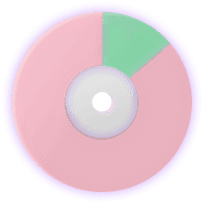
Correct
13.85%
Correct
13.85%
Pre-Survey
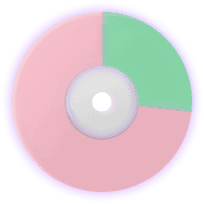
Correct
26.79%
Correct
26.79%
Post-Survey
Significance with Musical Background
Significance with Musical Background
I further analyzed most missed questions by sorting them based on musical background and noticed that most of the correct answers were from students who can read music.
I further analyzed most missed questions by sorting them based on musical background and noticed that most of the correct answers were from students who can read music.
For Loop with If-Else Statement Question
For Loop with If-Else Statement Question

Correct
91%
Correct
91%
Musicians
(Can Read Music)

Correct
25%
Correct
25%
Musicians
(Cannot Read Music)

Correct
48%
Correct
48%
Non-Musicians
While Loop Question
While Loop Question

Correct
55%
Correct
55%
Musicians
(Can Read Music)
Correct
25%
Correct
25%
Musicians
(Cannot Read Music)

Correct
20%
Correct
20%
Non-Musicians
Reflection and Observations
Reflection and Observations
Problem
Problem
Requirement for Prior Computational Thinking Skills
Transfer of computational thinking skills is critical in programming. Students struggled with basic concepts of logic and its
Low Student Engagement
Student lose interest because of the gap between theoretical concepts and real-world applications. Students seems to copy and paste the code snippets instead of understanding their use.
Solution
Solution
User-Centered Learning Environment
Create an environment that adapts to students' individual knowledge levels and personal interests
Engaging Educational Tools
Interactive platforms that spark curiosity and maintain student motivation
Design
03
Based on the workshop experience, I realized the need of new educational platform that integrates music and programming, where student can…
I create educational technology in naive approach of gamifying the intergrated learning of music and coding and presented at Educational Technology course.
First Iteration
First Iteration
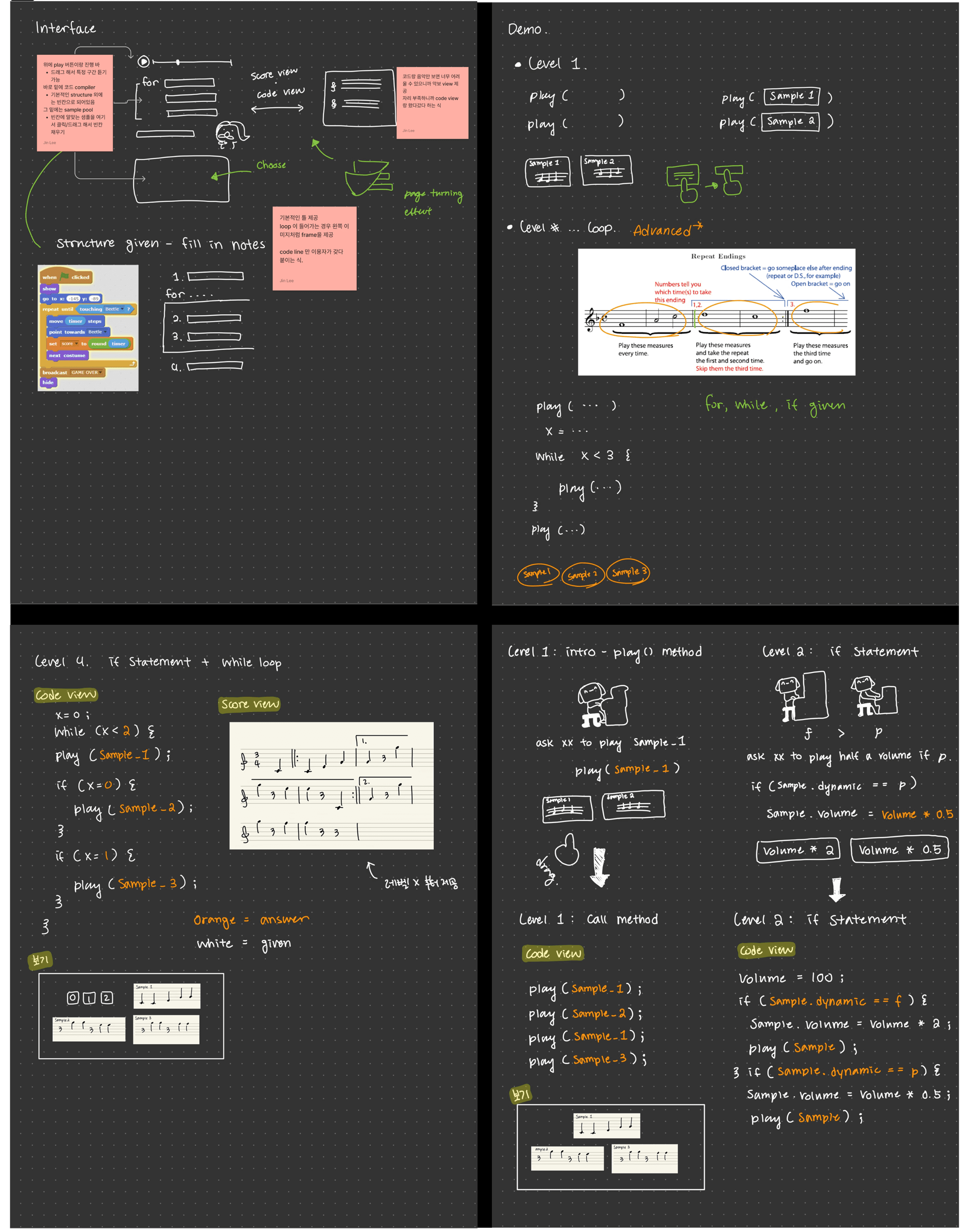
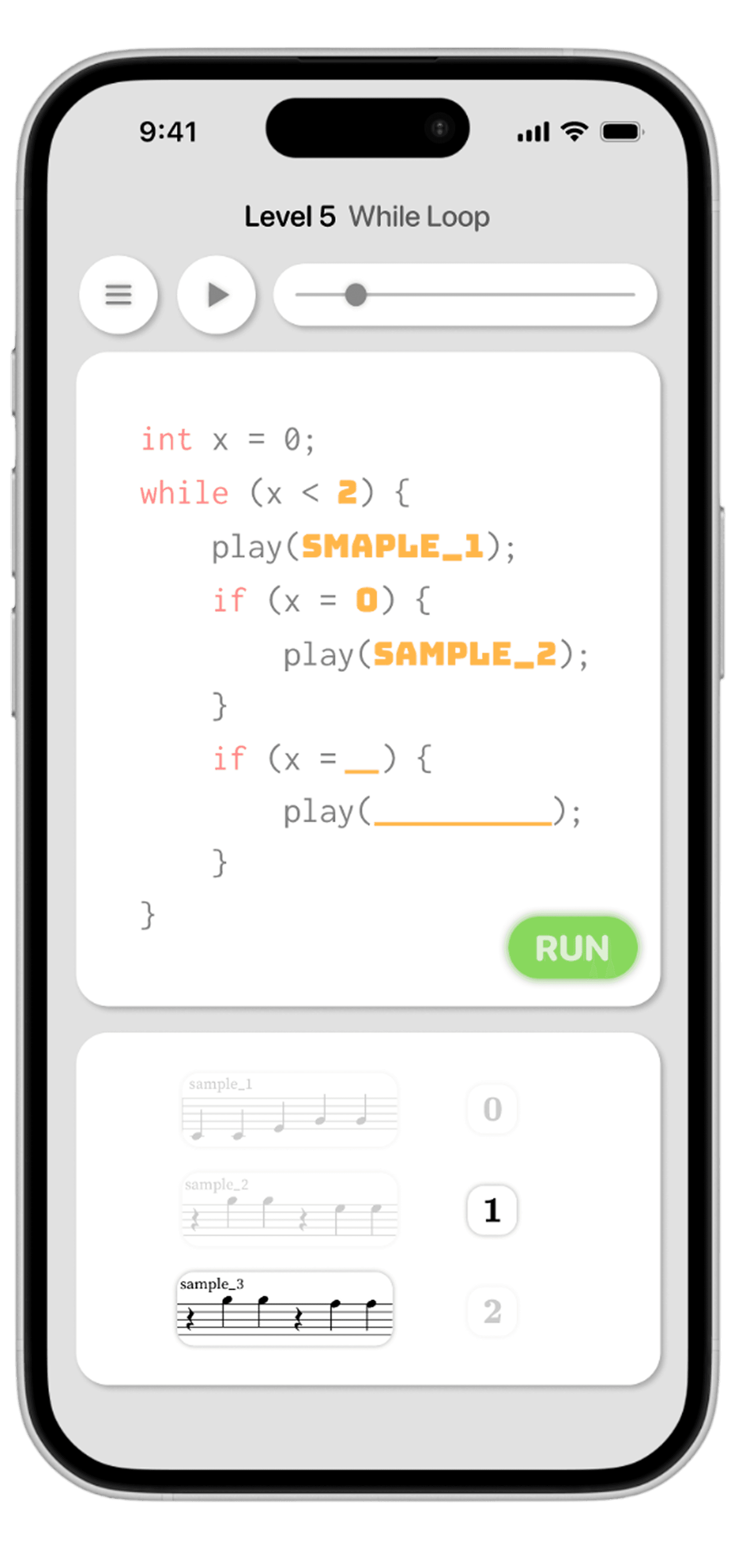
I further analyzed most missed questions by sorting them based on musical background and noticed that most of the correct answers were from students who can read music.
User tested…
Problem
Problem
Low Content due to Lack of Overlapping Concepts
Transfer of computational thinking skills is critical in programming. Students struggled with basic concepts of logic and its
Forced Learning (Duolingofied)
Student lose interest because of the gap between theoretical concepts and real-world applications. Students seems to copy and paste the code snippets instead of understanding their use.
Changes in Musical Trend
Student lose interest because of the gap between theoretical concepts and real-world applications. Students seems to copy and paste the code snippets instead of understanding their use.
Solution
Solution
Scale Down to Computational Thinking Development
Create an environment that adapts to students' individual knowledge levels and personal interests
Leverage on Existing Concepts
Create an environment that adapts to students' individual knowledge levels and personal interests
Focus on Popular Music
Interactive platforms that spark curiosity and maintain student motivation